Royal Bank of Canada is the fifth largest bank in North America and its investment arm RBC Capital Markets is a top 10 global investment bank. Their cloud platform team has just been awarded “Best cloud initiative” in the prestigious American Financial Technology Awards 2025. Congratulations!
At Kubecon we heard Erick Bourgeois present how this platform team has been working with ConfigHub. Erick provided examples of errors in cloud native configurations that caused serious outages and deployment delays. How can we eliminate operational and compliance risks by preventing such errors? In one case, it took three days to track down and fix the problem which had been caused by one misplaced space (Yes: “ “) in a config file.
Please watch Erick Bourgeois present the solution in this video and these slides. These set out the business case while I provide a demo of stopping an error that standard tools can’t prevent.
Three Key Lessons
In my view: Configuration errors place extreme stress on every person and process involved. The risk of a high blast radius event leads to extreme caution and slows down delivery. The industry needs better. We want to get you out of config hell!
Our solution must focus on three things:
- Time is money – when real world operations are disrupted, every second counts and we need configuration tools that make errors easy to find and fix.
- Config sprawl is a huge operational and compliance risk – configuration data is usually stored across a sprawl of Git files, templates and pipeline tools. This does not always behave predictably and when it breaks is hard to fix quickly.
- Configuration as Data solves this pain. We must fix the sprawl, and we must ensure correct and compliant changes can be applied quickly whatever the circumstances - including in “break glass” emergencies.
The problem of “sprawl” cannot be overstated. Kubernetes, containers, Helm, GitOps, IaC are all based on configuration. This is often bound up in template files in which bits of code are applied to bits of data through a complex sequence of git folders, delivery systems, pipelines, and production. Every DevOps user we spoke to complained about “too many moving parts” leading to a complete loss of visibility and operability. Changes take too long and compliance is unverifiable.
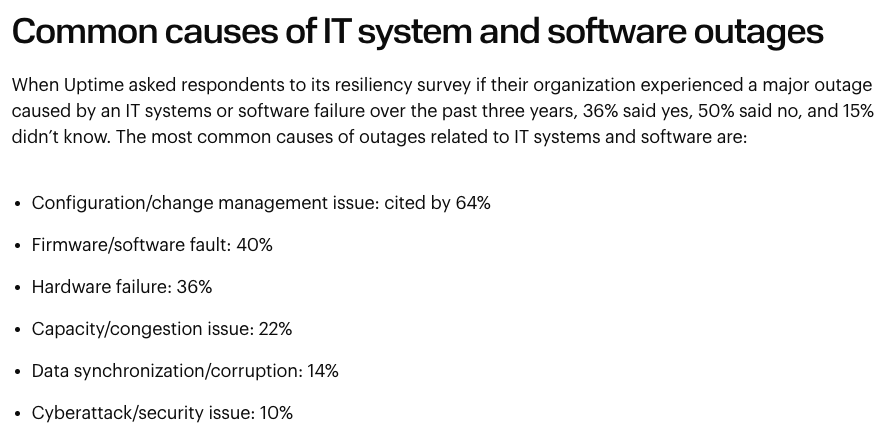
Quoting from the Uptime Institute in 2023 - Only 50% of respondents had not had a major outage in the last 3 years, and 64% of respondents said that Configuration and Change Management was the most common cause:
ConfigHub’s Solution: Config as Data
ConfigHub’s solution imports all the configuration data into one properly organized and managed database and API. This enables programmatic and agentic “workers” to detect, analyse, prevent and remediate such problems in live production.
In this new “Configuration as Data” model every live operational component corresponds to exactly one live configuration in the database. Problems like bad configurations, or security and compliance drift in production, can all be detected automatically and fixed using ConfigHub's APIs, before doing further harm.
Business Benefits
In the RBC talk, Erick lays this all out clearly. For example, in one case, an extra space in one Grafana data feed file led to a deployment error and 3-day cascade of breakages. To prevent these kinds of operational outages, the devops systems must be better controlled. Erick identified the cause: too many systems touching too many YAML and Helm files, leading to regular and painful errors. ConfigHub’s database and management tools simplify this.
Erick listed the following benefits:
- Reduced blast radius
- Enhanced transparency
- Faster CVE response
- Self-service workflows
- Click ops capability
- Automated compliance
Today RBC Cap Markets continues to use the Kubernetes platform with GitOps and Helm packages, but is bringing the operational aspects of deployment under control.
Let’s move forwards together
We need to get rid of configuration sprawl to create a foundation for better systems. This is now an urgent problem. Not only for platform teams with Kubernetes. The world is moving to generative AI and “vibe coding” AI. This is a potential time bomb: how will AI apps be deployed, operated and controlled? Managing their configuration is a must have.
If this blog post resonated with you, then get in touch.
Please go to www.confighub.com and sign up.
If you're already using GitOps tools, or plain vanilla Kubernetes and Helm, that’s fantastic. We are all set with tutorials and examples for you. Or if you are thinking about “where the puck is going” with AI Native applications and compliance, email me, we are here to listen and help.
–alexis
Find out more
- What is Configuration as Data and Why does configuration need an API?
- ConfigHub web site and product and docs especially Background Info
- ConfigHub open source SDK and examples - eg. Flux Bridge
- Helm example and Helm blog post
- Kubecon: Alexis write up of the week.
- Kubecon RBC's Erick video and slides
- Kubecon Brian's deeper dive video and slides
- IT Ops Times references ConfigHub at Kubecon - we need a new source of truth
- The New Stack article "eliminate configuration hell"
- Efficiently Connected article from theCube "New Model for Cloud Native Configuration"
- Techstrong interview me about CNCF and journey from GitOps to ConfigHub
- Artem Lajko: "why your internal developer platform needs confighub" introduction
- Brian’s blog is packed with tech ideas: bidirectional GitOps, config as data, and more
- Don’t forget to SIGN UP :-)
Questions or feedback? Email us at hello@confighub.com.